Round the tables: the long casino room
Seven tables, three games and a floor of broad boards, with trained dealers at every table and no money in play.
Seven tables in one long room
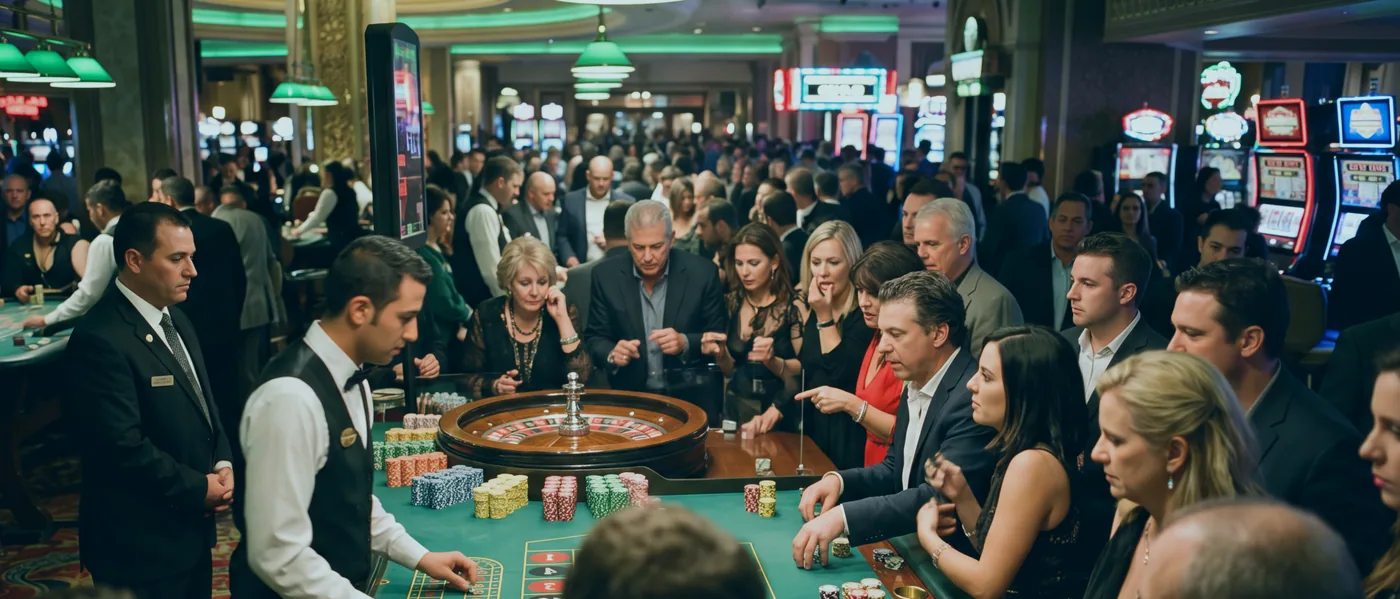
The casino room is entered through a wide archway at the back of the dining room. Its proportions are generous: nine metres of green baize and brass lamp, a ceiling lined with pressed metal and walls thick enough to keep the afternoon heat at bay. The effect is of a private library in which someone has replaced the books with card tables.
Two roulette wheels occupy the far end, where the croupiers can see the whole room. The wheels are traditional, with thirty-seven pockets, and each croupier calls the number clearly as the ball settles. Roulette is the most convivial of the three games, since any number of guests may place their chips on the layout at once.
In the middle of the room stand two blackjack tables, each seating five. The object is to hold a hand closer to twenty-one than the dealer's without exceeding it. The dealers explain each decision in plain language, and there is always a card on the table setting out when to stand, hit or double.
Nearest the archway are the three poker tables, each seating six. Texas Hold'em and Omaha are dealt on most evenings, with Seven Card Stud and Five Card Draw on announced nights. Poker tables are quieter than the others, and their regulars prefer it that way.
All play is conducted on house chips with no cash value, in person, in this room only. The house has no pokies, no gaming machines and no online tables. Guests must be 18 or over.
The proportions of the room are deliberately modest. It is possible to stand at one end and hear the wheel at the other, and to follow the conversation at the next table without leaning. Dealers rotate between tables every hour, so that no croupier grows tired and no guest feels that a particular seat belongs to a particular person.
Roulette
Two wheels with thirty-seven pockets and a croupier each
Blackjack
Two tables of five, with a printed guide at every seat
Poker
Three tables of six, dealt in four forms
How each game runs
Roulette: place your chips
Before the ball is spun, guests place chips on the layout: on a single number, on a colour or on a block of numbers. The croupier announces when the table is open and when it is closed.
Roulette: the spin
The croupier sets the wheel turning, releases the ball in the opposite direction and waits for it to fall. When it settles in a pocket, the croupier calls the number and marks the winning position on the layout.
Roulette: the next round
Chips are cleared by the croupier, and the next round begins. There is no pressure to place chips in every round, and guests may sit out as many spins as they like.
Blackjack: the deal
Each player receives two cards, and the dealer receives one face up and one face down. Cards numbered two to ten count at face value, court cards count as ten and an ace counts as one or eleven.
Blackjack: the decision
Each player in turn chooses to take another card or to stand. A hand that exceeds twenty-one is out. When every player has decided, the dealer reveals the second card and plays out the hand.
Poker: the blinds and the hole cards
In Hold'em, every player receives two private cards, and five shared cards are turned over in stages. Two players post small forced counters, called blinds, to start the action each round.
Poker: the rounds of action
After each stage, players may check, raise, call or fold, using chips with no value. The rounds continue until one player remains or the final cards are shown and compared.
Poker: the showdown
Remaining players reveal their hands, and the best five-card combination takes the pot of chips. The dealer announces the result, moves the marker and begins the next hand.
Seven Card Stud and Five Card Draw
Stud deals each player seven cards over several rounds, using the best five. Draw gives five cards at once, with a chance to exchange some. Both are announced in advance.
Rotating the dealers
At the end of each hour, the dealers rotate between tables, and the floor manager announces the change. Chips and cards are checked by both dealers before the new one takes over, and the game resumes without a pause.
Leaving the table
A guest who leaves a table returns the chips to the dealer, who counts them in the guest's presence and puts them away in the tray. Nothing is carried out of the room, and nothing is owed on either side.
About the casino room
Can I watch before deciding to play?
Certainly. Seats are provided along the side of the room for guests who would prefer to observe for a time. The dealers are pleased to answer questions during a lull, and nobody is asked to join a game.
Are the tables open to guests who have not dined?
Yes. The casino room is open to all guests aged 18 or over, whether or not they have eaten at the house. Seats are offered in the order of arrival, and a waiting list is kept for each table.
What should I wear?
There is no formal dress code. Clean, tidy clothing is expected, and most guests come from work or the road. The room can be cool in the evenings, so a light jacket is sensible.